

What should a kinship care resource pack include?
A kinship care resource pack should include clear information about the child’s legal arrangement, carers’ rights and responsibilities, safeguarding, financial support and relevant professional contacts. It should also provide practical guidance on routines, education, health, emotional wellbeing, family communication and record-keeping, with resources appropriate to the child’s age and circumstances.
Partnering with an
Ofsted Outstanding Provider
A useful kinship care resource pack is a personalised, regularly updated collection of information, documents, checklists and contacts that helps everyone understand the child’s care arrangements and manage day-to-day decisions consistently. It should be easy to use during ordinary routines as well as at appointments, meetings or periods of change.
Begin with a contents page and child profile. The pack should identify which documents it contains and explain who is responsible for keeping it current. A child profile can include:
- the child’s preferred name, date of birth and important relationships;
- communication preferences, interests, strengths and things that may cause distress;
- important routines, comfort items, dietary information and cultural or faith needs;
- details of school or nursery, health professionals and other regular services; and
- the child’s own views, recorded in language and a format suitable for their age and understanding.
The profile should be factual and respectful. It should not define the child by difficult experiences or include information that does not need to be shared. Where the child can contribute, their views should be checked with them and updated as their circumstances develop.
Include a clear document and contact directory. Keep copies of key correspondence, plans, assessments, meeting notes and agreed actions together, with the date of each document clearly shown. A contact list should distinguish between relatives, school staff, health professionals, social care contacts, advocacy services and other practitioners. For each contact, record their role, organisation and the reason they should be contacted. This prevents carers from relying on an old telephone number or contacting the wrong professional about a particular issue.
Add practical templates rather than relying on memory. Useful templates may include:
- a weekly routine and appointment planner;
- a medication, treatment or health-appointment record where relevant;
- a school communication sheet and homework or activity checklist;
- a contact record for conversations, visits and agreed arrangements;
- a expenses and receipts log, where costs need to be recorded; and
- a list of questions to take to reviews, meetings and professional appointments.
Templates should have space for dates, actions, responsible people and follow-up points. A brief factual record is generally more useful than a long narrative. Carers should separate observations from assumptions and keep records securely, particularly where they contain sensitive information about the child or other family members.
Provide age-appropriate explanation materials. A child may need a simple explanation of who they live with, who makes particular decisions, what contact with relatives involves and which adults they can speak to if they are worried. The pack might contain diagrams, calendars, question prompts or a life-story activity suited to the child’s age and communication needs. Information should be presented in a way the child can revisit, rather than being treated as a single conversation.
Cover relationships and communication within the family. Include an agreed plan for sharing information with parents, siblings, relatives and other household members. This should clarify what can be discussed, what should remain private, how disagreements will be raised and how the child’s wishes will be considered. A short household agreement can also set out expectations around privacy, photographs, social media, visitors, personal belongings and conversations about the child’s history.
Include a review and change log. The pack should show when each section was last checked and identify changes such as a move of school, new professional involvement, altered family contact, a health development or a change in the child’s views. Remove superseded copies or mark them clearly so that outdated instructions are not followed. Reviewing the pack at agreed meetings, and whenever circumstances change, keeps it accurate without requiring every section to be rewritten.
Make the format usable for the whole household. A good pack may combine a secure paper folder with an electronic copy, provided both are protected and kept consistent. Use plain language, readable print and clear labels. Separate information that the child can access from confidential professional records. Consider translation, large print, visual communication or other adjustments where these help a child or carer understand the information.
Finally, include a short checklist for evaluating new material before adding it: who produced it, when it was published or reviewed, which type of kinship arrangement it applies to, whether it reflects the child’s circumstances and whether professional advice is needed before acting on it. A resource pack should support informed conversations with the relevant professionals; it should not be used as a substitute for advice tailored to the child’s legal, health, educational or family situation.
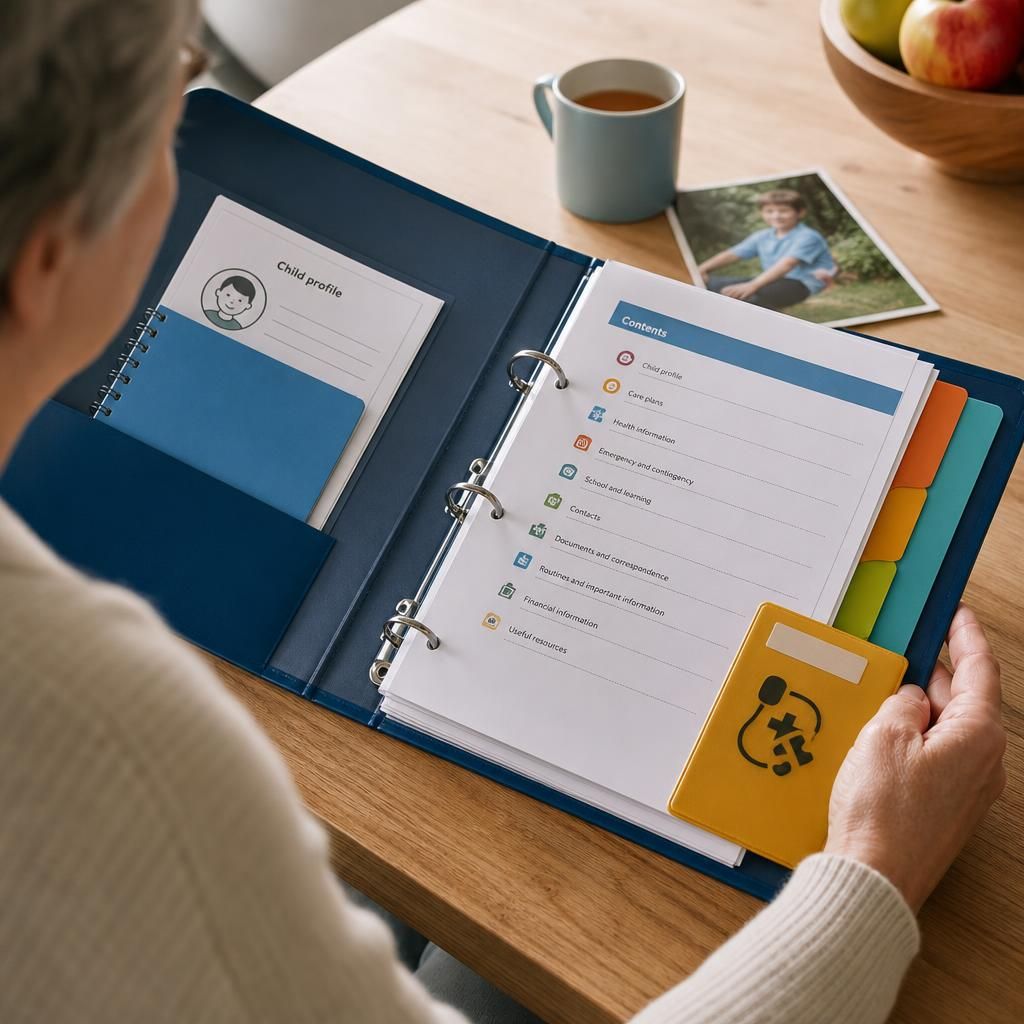
A kinship care resource pack should include a clearly marked emergency and contingency section, separate from routine guidance. This section helps carers act consistently if the usual care arrangements cannot continue or an urgent concern arises.
- Contact details and instructions for reporting an immediate safeguarding concern or medical emergency.
- A plan for who should care for the child if the kinship carer becomes ill, is admitted to hospital or cannot return home.
- Important information to give another trusted adult, including essential routines, health needs and relevant professional contacts.
- Steps to follow if a child is missing, a planned family contact arrangement breaks down or an unexpected change affects their safety.
- A note explaining when the carer should contact the child’s social worker, local authority, school, health professional or legal adviser.
Keep this section brief enough to use under pressure, with instructions written in order of priority. Check it whenever the child’s needs, household circumstances or professional contacts change, and ensure that any substitute carer knows where it is kept and what information they are authorised to access.
Explore more kinship care resources
Explore more kinship care resources to find practical guidance for the child’s legal arrangement, wellbeing, relationships and day-to-day care.