

How are house rules tailored to each young person in group foster care?
House rules in group foster care are tailored through the young person’s care plan, risk assessment, age, understanding, needs and background. Staff set clear, consistent boundaries for safety and shared living, while adjusting routines, privacy arrangements, responsibilities and permitted activities as the young person develops and their circumstances change.
Partnering with an
Ofsted Outstanding Provider
House rules in group foster care are usually tailored by combining a consistent house framework with individual arrangements for each young person. The shared rules protect everyone’s safety and help the home run predictably, while the individual arrangements explain how those rules apply to a particular young person and what support they may need to follow them.
The starting point is an individual discussion before, or shortly after, placement. Staff consider information available from the placing authority, the young person, their family where appropriate, and other professionals involved in their care. The young person should be given a clear explanation of the rules in language they understand. Their views, worries and preferences can then be considered when agreeing practical arrangements.
This distinction is important: tailoring does not mean removing necessary safeguarding boundaries or allowing one resident to behave in a way that places others at risk. It means applying expectations fairly and making sensible adjustments where a young person’s circumstances affect how they manage daily life.
- Daily routines: arrangements may cover waking, meals, school or education, personal care, activities and bedtime. A young person who finds sudden changes difficult may need advance notice, visual reminders or a more gradual transition between activities.
- Shared spaces: rules about kitchens, bathrooms, lounges and communal equipment can be explained alongside any personal arrangements. Staff may need to consider sensory sensitivities, mobility requirements, dietary arrangements or the need for additional supervision.
- Contact and visitors: arrangements for seeing family, receiving visitors or using communication devices should reflect agreed contact plans and safeguarding information. Staff must also consider the privacy and safety of other young people living in the home.
- Personal belongings: expectations about storing, sharing and looking after possessions can be adapted where a young person needs help with organisation or has particular cultural, religious or personal requirements.
- Responsibilities: chores and household contributions should be realistic and proportionate. A young person may start with a small, supported task and take on more responsibility as their confidence and practical skills develop.
Rules should be written in positive, straightforward terms wherever possible. Instead of relying only on prohibitions, staff can explain what the young person is expected to do, why the expectation exists and what help is available. This makes boundaries easier to understand and reduces the risk that a rule will feel arbitrary or personal.
Consistency between staff members is also part of effective tailoring. The agreed arrangements should be recorded in the relevant care and placement documentation, so that staff respond in a similar way. Important information may include known triggers, helpful de-escalation approaches, communication preferences, agreed levels of independence and circumstances in which additional support is required.
Young people should be involved in reviewing their rules rather than being treated as passive recipients of them. Staff can check whether an arrangement is working, whether the young person understands it and whether it is helping them take part in ordinary home life. Reviews may also involve the social worker, carers, family members or other professionals where their contribution is relevant and appropriate.
Rules may need to be reconsidered after a significant change, such as a move in education, a change in contact arrangements, an incident, a health concern or a noticeable improvement in independence. Any change should be explained clearly and recorded. Temporary restrictions should have a clear reason, be proportionate to the concern and be reviewed rather than becoming an informal permanent rule.
When a young person does not follow a rule, staff should look at what happened before deciding how to respond. The issue might involve confusion, distress, an unmet need, peer pressure or a rule that has not been explained effectively. Consequences should be reasonable, connected to the behaviour where possible and consistent with the young person’s care arrangements. They should not humiliate the young person, remove essential care or undermine their basic rights.
Good house rules therefore provide structure without treating every young person identically. They create a predictable foundation for communal living, while allowing support, responsibility and independence to be adjusted through ongoing observation, discussion and review.
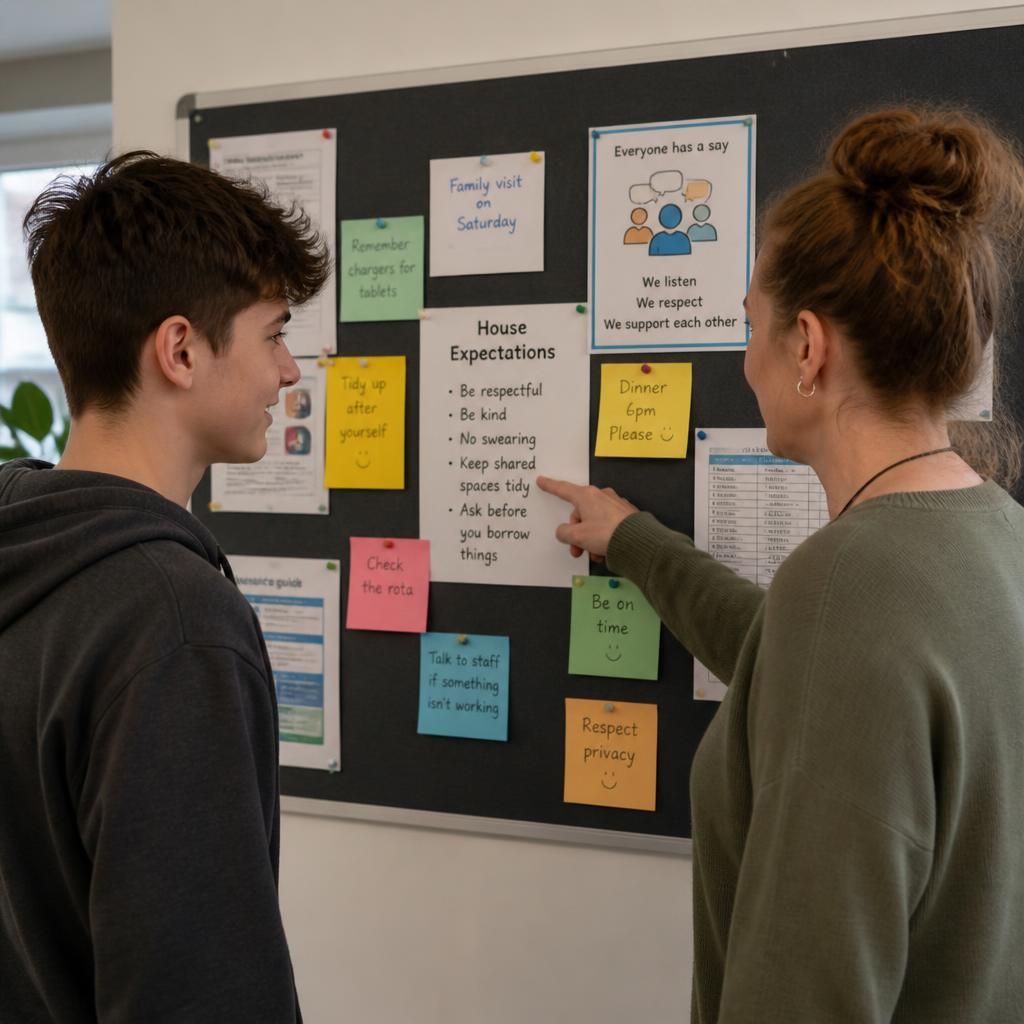
House rules must be distinguished from formal restrictions on a young person’s rights. A group home cannot introduce a blanket rule simply because it is convenient for staff if the effect is to limit contact, movement, communication, education or personal choices. Any restriction should have a clear safeguarding or care-related reason and be considered through the young person’s care and placement arrangements.
This distinction helps staff tailor support without making ordinary house expectations unnecessarily restrictive. The young person should be told what the restriction is, why it applies, who has agreed it and when it will be reconsidered. Their social worker, advocate or other relevant professional may need to be involved, particularly where the restriction is significant or disputed. This provides accountability and ensures that individual rules remain proportionate to the young person’s circumstances rather than becoming permanent features of group living.
Ask our fostering team about group foster care
Ask our fostering team about group foster care and how each young person’s individual arrangements are considered alongside shared house expectations.